About us:

About us: The Northern Virginia STEM Learning Network was established by Virginia Tech in 2007 as an informal network of STEM educators, maintained by Virginia Tech's DC Area Technical Education and Workforce Development Team. It became a formal part of the DMV Ecosystem in 2021 until that ecosystem grant expired in 2024. In October 2025 we received national recognition for our ecosystem and were now building the architecture to accomplish our goals. Please join us. STEM@vt.edu or Workforce@vt.edu

Thursday, August 22, 2013

Connecting with Students

Bill Daggett always promoted rigor, relevance and relationships. As a new teacher that certainly appealed to me; but I have often found academic rigor to be inauthentic, driven by excess workloads rather than deeper understanding, analysis, real skills, and creative applications of learning.  Worse, that rigor was reinforced by artificial grading policies based on strange point systems developed by people who would struggle if you asked, "What exactly does your grade mean?" 

But this blog post reminded of Ray McNulty in promoting Project-based Learning:  if you emphasize relevance and relationships, the students themselves help create the rigor, and nearly everyone enjoys and benefits from that kind of learning environment.
- Jim E.

========

Reposted from the JD 24/7 blog:

My Photo
Jeff Delp

60 Ways to Connect with Your Students

Coming to school each day can become a hopeless task for some children unless they succeed at what they do. We teachers are the sentries against that hopelessness.  ~ Robert DeBruyn

If you know me, or you are a regular reader of my blog, you know that I have a passion for working with challenging students, and that I place an extremely high degree of importance on the “human element” of the education profession.  I certainly do not discount the value of content knowledge, but I am a true believer in the power of educators to build hope in those students who may have lost it, and generate the sparks that ignite the flames of lifelong learners.

In order to do that, it is imperative that we know our students (see We Need to Know), and do everything within our power to develop meaningful connections.  This doesn’t have to be an elaborate, or time consuming process.  In fact, it is often the the little things that have the most significant impact.  Here is a list of sixty ideas to get you started on the road to building strong connections with your students (in no particular order).
  1. Learn their names
  2. Call them by their name...every chance you get
  3. Leave a positive message on voicemail (so the parent, and the student can listen)
  4. Ask them to help with something in the classroom, or run an errand
  5. Call on them when you know they have the answer
  6. Smile frequently
  7. Take an interest in the little things - “I notice that you…”
  8. Write a note of encouragement
  9. Eat lunch with them
  10. Attend an event in which they are participating (i.e. concert, athletics, etc.)
  11. Post-It note positivity -- drop a note on as their desk (a smiley face, “great job,” etc.)
  12. Sponsor a club, or extracurricular activity
  13. Share about yourself
  14. Show appreciation - say “thank you” and “please”
  15. Involve them in classroom decision making
  16. Laugh with them
  17. Be willing to laugh at yourself
  18. Spend time outside of your classroom before, during, and after school
  19. Heap on the praise and encouragement
  20. Call home when a they are absent -- let them know you are concerned, and that they are missed
  21. Give up some control (I know...that makes you nervous)
  22. Find ways to let them see that they can make a difference
  23. Give them opportunities to pursue their personal interests
  24. Admit your mistakes
  25. Tell them “I’m sorry,” when it’s called for
  26. Demonstrate empathy and compassion
  27. Learn about your their home/family situation
  28. Share your frustrations, and model how to handle them appropriately
  29. Keep Jolly Ranchers on hand (I know...it’s a bribe...but it can be a conversation starter)
  30. Point out, and celebrate, small victories
  31. Help them set attainable goals
  32. Go out of your way to give them a quick hello -- when they aren’t in your class
  33. Greet students at your classroom door
  34. Say, “I believe in you. I know you can do it.”
  35. Have high expectations, and back it up with a high level of support
  36. Build grit -- tell them to “keep trying”
  37. Be patient
  38. Be persistent
  39. Show grace
  40. Model respectful interactions
  41. Give a sincere compliment
  42. Ask them about their weekend
  43. Intentionally plan for opportunities for them to experience success (write it in a lesson plan)
  44. Address concerns in a way that maintains their dignity
  45. Say, “You are someone. You are going places.”
  46. Recognize when students are having a tough day, and give them a break - it happens to all of us
  47. Hold them accountable for what they say they will do
  48. Follow through on what you say you will do
  49. Give meaningful feedback
  50. Praise effort
  51. Don't make assumptions (or Assume the Best)
  52. Make relationships a priority
  53. Tell students you are proud of them
  54. Slow down, be present, listen
  55. High fives, fist bumps and handshakes
  56. Stay away from your desk, or out of the office
  57. Be an advocate
  58. Find something you have in common
  59. Talk about their future as a definitive - “When you get to high school…”, etc.
  60. Tell students, “you matter!"
I challenge you to pick two, or three, of these ideas from the list and be intentional about putting them into practice on a daily basis. Continue to add to your strategies throughout the school year. If something isn’t working, try something else.

Sunday, August 18, 2013

Gourd Math and Science

Reposted from Mary Van Dyke's Green STEM Learning Blog at greenstemlearning.blogspot.com

 Back to School: ideas for play, math, science and design with gourds, pumpkins and squash


Here for K- 5 educators - ideas for play, math, science and design with gourds, pumpkins and squash.


Gourd Math from MaryVanDyke

Check out planting, growing and harvesting details for gourd family plants in your zone.
Here in VA, gourds, pumpkins and squash are easy to plant in May and June.
The plants can then look after themselves over the summer vacation...and will be ready to harvest when kids go back to school in the fall.

Wednesday, July 3, 2013

Google Insight on Recruiting, Hiring, GPA's and Test Scores

From Adam Bryant, Corner Office Columnist at The New York Times

on LinkedIn


On GPAs and Brainteasers: New Insights From Google On Recruiting and Hiring

“We found that brainteasers are a complete waste of time. How many golf balls can you fit into an airplane? How many gas stations in Manhattan? A complete waste of time. They don’t predict anything. They serve primarily to make the interviewer feel smart.”
That was just one of the many fascinating revelations that Laszlo Bock, Google’s senior vice president for people operations, shared with me in an interview that was part of the New York Times’ special section on Big Data published Thursday.
Bock’s insights are particularly valuable because Google focuses its data-centric approach internally, not just on the outside world. It collects and analyzes a tremendous amount of information from employees (people generally participate anonymously or confidentially), and often tackles big questions such as, “What are the qualities of an effective manager?” That was question at the core of its Project Oxygen, which I wrote about for the Times in 2011.
I asked Bock in our recent conversation about other revelations about leadership and management that had emerged from its research.
The full interview is definitely worth your time, but here are some of the highlights:
The ability to hire well is random. “Years ago, we did a study to determine whether anyone at Google is particularly good at hiring,” Bock said. “We looked at tens of thousands of interviews, and everyone who had done the interviews and what they scored the candidate, and how that person ultimately performed in their job. We found zero relationship. It’s a complete random mess, except for one guy who was highly predictive because he only interviewed people for a very specialized area, where he happened to be the world’s leading expert.”
Forget brain-teasers. Focus on behavioral questions in interviews, rather than hypotheticals. Bock said it’s better to use questions like, “Give me an example of a time when you solved an analytically difficult problem.” He added: “The interesting thing about the behavioral interview is that when you ask somebody to speak to their own experience, and you drill into that, you get two kinds of information. One is you get to see how they actually interacted in a real-world situation, and the valuable ‘meta’ information you get about the candidate is a sense of what they consider to be difficult.”
Consistency matters for leaders. “It’s important that people know you are consistent and fair in how you think about making decisions and that there’s an element of predictability. If a leader is consistent, people on their teams experience tremendous freedom, because then they know that within certain parameters, they can do whatever they want. If your manager is all over the place, you’re never going to know what you can do, and you’re going to experience it as very restrictive.
GPAs don’t predict anything about who is going to be a successful employee. “One of the things we’ve seen from all our data crunching is that G.P.A.’s are worthless as a criteria for hiring, and test scores are worthless — no correlation at all except for brand-new college grads, where there’s a slight correlation,” Bock said. “Google famously used to ask everyone for a transcript and G.P.A.’s and test scores, but we don’t anymore, unless you’re just a few years out of school. We found that they don’t predict anything. What’s interesting is the proportion of people without any college education at Google has increased over time as well. So we have teams where you have 14 percent of the team made up of people who’ve never gone to college.”
That was a pretty remarkable insight, and I asked Bock to elaborate.
“After two or three years, your ability to perform at Google is completely unrelated to how you performed when you were in school, because the skills you required in college are very different,” he said. “You’re also fundamentally a different person. You learn and grow, you think about things differently. Another reason is that I think academic environments are artificial environments. People who succeed there are sort of finely trained, they’re conditioned to succeed in that environment. One of my own frustrations when I was in college and grad school is that you knew the professor was looking for a specific answer. You could figure that out, but it’s much more interesting to solve problems where there isn’t an obvious answer. You want people who like figuring out stuff where there is no obvious answer.”

Tuesday, June 18, 2013

A New Teacher Preparation Rating Effort

There are too many confounding variables and some very obvious bias in this report for me to give it much consideration, but it's impact will be felt through misleading headlines and broadcast journalist bimbo and himbo oversimplification.  So I'm sure we'll all want to be familiar with it.


Teacher Prep Review 2013 Report

June 2013

The first edition of the NCTQ Teacher Prep Review is an unprecedented evaluation of more than 1,100 colleges and universities that prepare elementary and secondary teachers. As a consumer tool, it allows aspiring teachers, parents and school districts to compare programs and determine which are doing the best -- and worst -- job of training new teachers.

Saturday, May 25, 2013

Disruptive Technologies that will drive Disruptive Innovation

reposted from


These 12 technologies will drive our economic future

By Neil Irwin, Updated: 

Most of the writing you see about the economy speaks to narrow questions: What will growth be this year? When will the unemployment rate get back to normal? And so on. But the things that will determine standards of living a generation from now have almost nothing to do with this month’s jobs report or the Federal Reserve’s latest policy meeting. Those determinants, instead, depend on companies’ innovations — in particular, whether those innovations turn out to have major economic consequences.
Researchers at the McKinsey Global Institute, the in-house think tank of the giant consulting firm, have a new study in which they have taken their best shot at predicting exactly that. They have scoured the range of potential disruptive technologies and done their best to estimate how transformative each might be for the U.S. economy. Their results are hardly definitive — we can’t know what the future holds — but represent a serious effort by some smart people to quantify what appear to be some major forces shaping our technological future. And the results have some important implications for how we think about innovation.
First, the researchers, led by James Manyika, narrowed their focus to technologies that are already advancing rapidly (no pure pie-in-the-sky stuff), have broad potential impact (not something that would just affect one or two industries) and could have significant economic impact (the total numbers are large). Not making the cut were technologies that are unlikely to be available between now and 2025 (fusion power, for example) and those that are coming to fruition but are niche products (like private space flight).
Here’s the list the McKinsey researchers came up with, along with their (very rough) estimates of how much economic potential they hold. They are defining that economic impact broadly to include benefits that won’t show up in economic statistics like GDP (consumer surplus is the value people derive from an innovation that they do not pay for).

Source: McKinsey Global Institute

As the chart shows, the McKinsey folks believe that the most economically significant technologies over the next decade-plus will be those already well underway in their development — the mobile Internet, largely in place in the advanced world and rapidly growing in emerging markets; the automation of knowledge work, things such as  computerized voices that can handle many customer service calls; the “Internet of things,” such as embedding sensors in physical objects to monitor the flow of products through a factory; and cloud computing. Each of these areas of innovation, in the McKinsey telling, will be worth north of $1 trillion to the world economy by 2025, even on the low side of their range. (Find detailed definitions of each category here, and click on the full study to read the researchers’ methodology and rationale for these estimates).

Thursday, May 23, 2013

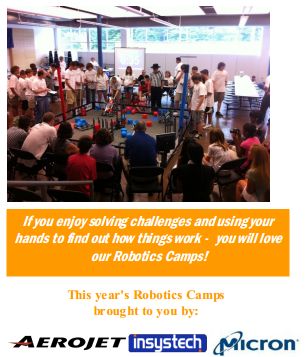
HS / MS Summer STEM Robotics Camp in Arlington


VEX Robotics   July 8-19, 2013
Monday-Friday, 12:30pm to 4:30pm

Arlington Career Center Summer STEM Programs

  Please call 703-228-5731 to enroll.


This camp is ideal for middle and high school students new to VEX robotics as well as students who may have already participated on a team, but would like to increase their programming and building skills.


VEX Robotics projects encourage teamwork, leadership and STEM problem solving among groups.


VEX also provides flexibility in meeting every student's interest and ability.  


Fee: $557.00   Free/Reduced Tuition:  $56.00


The VEX platform is affordable, and is expanding rapidly throughout middle schools, high schools and university labs around the globe.


Robotics hobbyists also appreciate the advanced capabilities of the VEX System.


This program is supported by NOVA SySTEMic Solutions, which currently has a team competing at the national level.      


Instructor:  Robb Dudek robert.dudek@apsva.us